
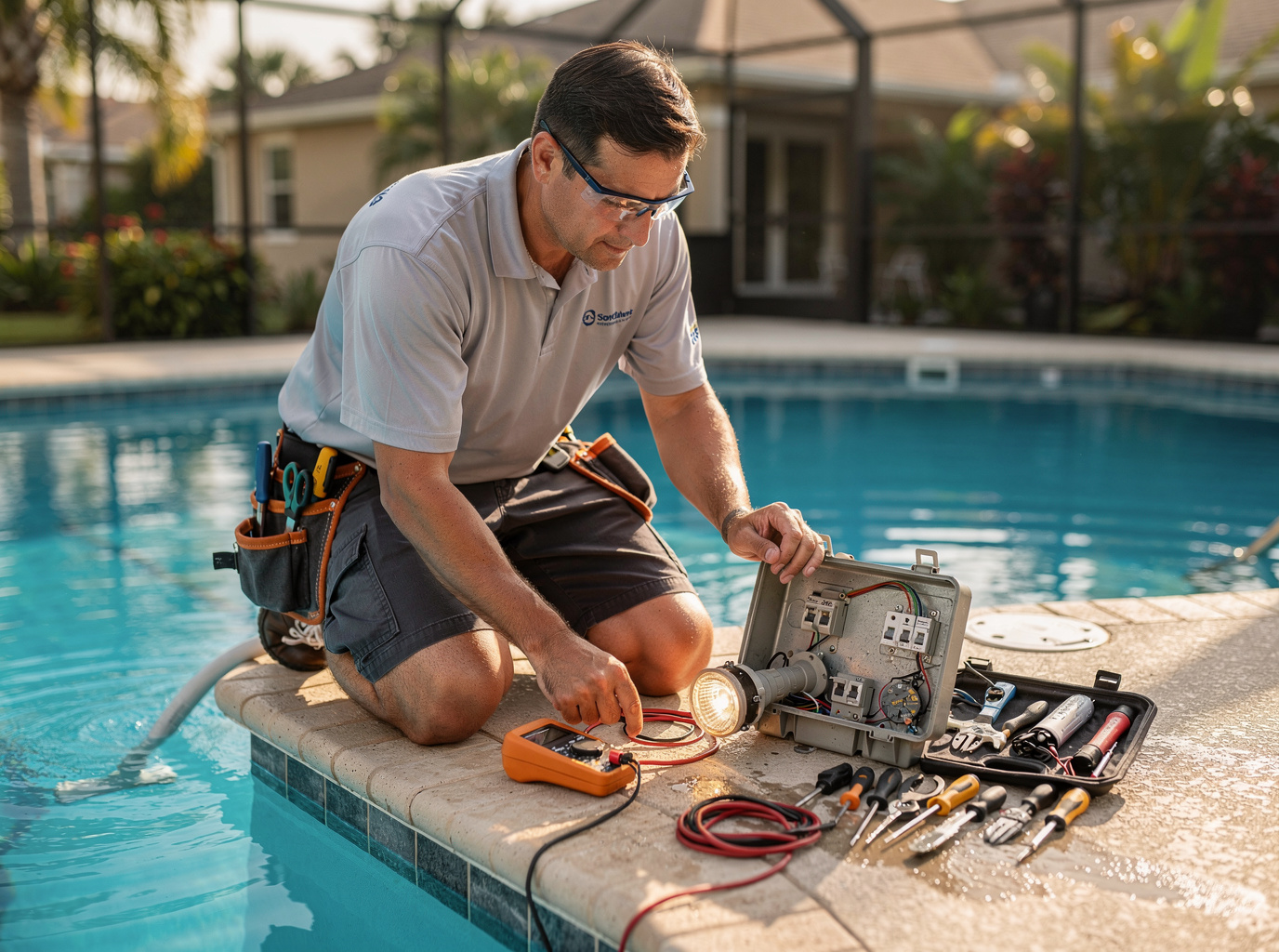
Pool lights in Clermont often trip GFCIs because the humid subtropical summers drive moisture past aging seals and into the fixture housing. Homes in the Clermont Historic District frequently have original 1970s or 1980s wiring that lacks modern grounding, so even small amounts of condensation create a ground fault. Lake County soil stays damp year-round, which accelerates corrosion on conduit and junction boxes located near the pool deck.
When a light keeps tripping, the first step is isolating whether the fault is in the fixture, the cord, or the breaker itself. Many properties near Lake Louisa State Park sit on slightly elevated terrain that still collects runoff during heavy summer storms, pushing water into buried conduits. Technicians check for nicks in the cord where it enters the wet niche and test for continuity after the breaker has been isolated.
Upgrading to a waterproof LED fixture with a new GFCI-protected circuit is common on homes in Lake Highlands where the original 120-volt lights were never rated for constant submersion. Mild winters do not dry out the equipment the way colder climates would, so any breach in the seal stays wet and conductive. Proper torque on the niche ring and dielectric grease on all connections prevents repeat trips after the repair.
Technician insight
In Clermont the thing that catches most people out with pool light GFCI trips is water sitting in the conduit runs after summer storms because the mild winters never fully dry the ground around Lake Highlands homes; the Historic District wiring is often the original two-wire setup with no separate equipment ground, so one small seal failure turns into constant tripping.
Lake Highlands Home With Recurring Trips
A homeowner near Clermont Waterfront Park reported the pool light tripping the GFCI every evening after the pump ran. Inspection showed moisture had entered the cord at the wet niche where the original seal had hardened. The cord was replaced, the niche was resealed, and a dedicated GFCI breaker was installed; the light has stayed on without tripping through multiple rain events.
Pool Light Keeps Tripping GFCI Services We Offer
✓GFCI Breaker Replacement
Swap the tripping breaker for a new 20-amp GFCI unit rated for pool equipment and verify panel bonding at the service entrance.
✓Pool Light Fixture Seal Inspection
Remove the lens, check the gasket and O-ring condition, and reseal with marine-grade silicone to stop moisture entry in humid summers.
✓Underwater Light Cord Repair
Locate and repair nicks or corrosion in the cord where it exits the wet niche, then test insulation resistance before re-energizing.
✓Circuit Separation for Lights and Pump
Split shared circuits so the pool light runs on its own GFCI-protected line, reducing nuisance trips from pump motor startup.
✓Corroded Ground Rod Testing
Test and replace ground rods or bonding jumpers affected by Lake County soil moisture that can create intermittent faults.
Pool Light Keeps Tripping GFCI Cost in Clermont, FL
| Service | Typical Range | What Affects It |
|---|---|---|
| GFCI Breaker Replacement | $180–$320 | Higher when panel access is tight in older Historic District homes |
| Light Cord Or Seal Repair | $250–$450 | Varies with niche depth and whether the cord must be fished |
| Full Fixture Replacement | $350–$550 | Includes LED upgrade and new seals |
| Circuit Separation Work | $400–$700 | Depends on distance to panel and trenching needs |
Ranges are typical for Clermont, FL and confirmed with an exact written quote before any work starts.
How it works
- 1
On-Site Diagnosis
Isolate the light circuit, measure leakage current, and inspect the fixture and conduit for water intrusion.
- 2
Component Testing
Megger the cord, check the GFCI breaker trip threshold, and examine the wet niche for corrosion.
- 3
Targeted Repair
Replace seals, cord sections, or the breaker as needed and restore proper bonding.
- 4
Verification And Documentation
Run the light for a full cycle, confirm no trips, and note any recommendations for the homeowner.
Pricing
Upfront quote after inspection; most jobs fall in the mid-hundreds depending on parts required.