
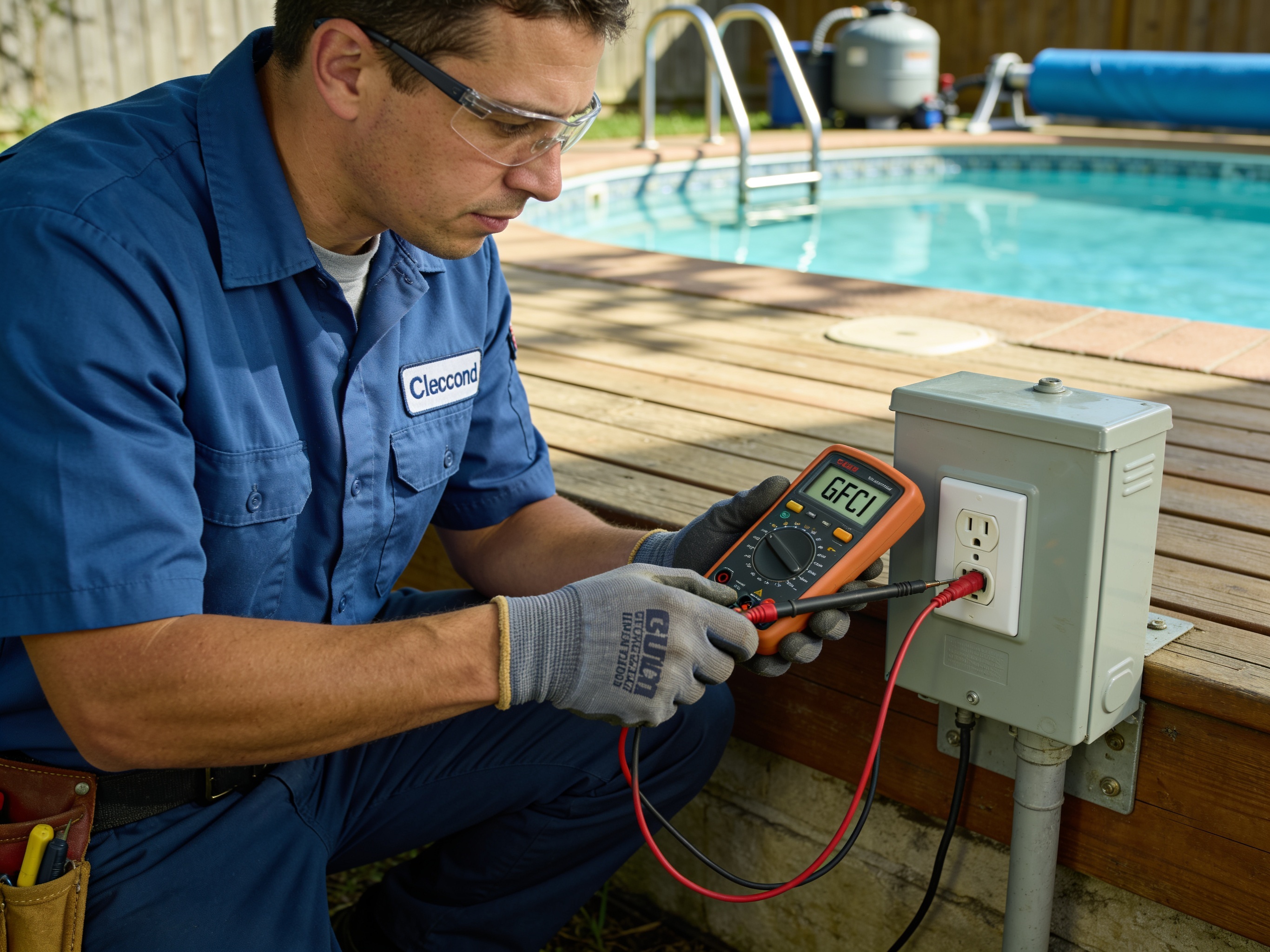
Clermont's humid subtropical weather brings frequent moisture intrusion into pool electrical systems, especially around older homes in the Clermont Historic District and Lake Highlands. Constant humidity accelerates corrosion on GFCI terminals and wiring connections that feed pumps and lights. Many properties near Clermont Waterfront Park sit on slightly elevated terrain that still channels rainwater toward equipment pads, creating repeated ground faults. Technicians often find that standard residential GFCI devices fail faster here than in drier nearby cities such as Leesburg because the combination of heat and moisture breaks down insulation within two to three seasons.
Pools in Lake County frequently use older 120-volt circuits that predate current pool code requirements for double-pole GFCI protection. When these circuits serve both pumps and underwater lights, a single tripped GFCI can shut down the entire system. Homeowners in Downtown Clermont sometimes replace the device themselves only to see it trip again within days because the root cause lies in deteriorated conduit or a failing pump motor winding. Proper diagnosis requires isolating each load with a megger and checking for moisture inside junction boxes that sit close to the waterline.
Seasonal patterns matter. Mild winters allow pool use year-round, so equipment runs continuously while condensation forms inside enclosures during cool nights. By midsummer the same boxes bake under direct sun, expanding and contracting seals until water enters. A technician based at 13202 Olesen Ct regularly sees tripped GFCIs traced to nicked underground feeders between the house and the pool pad, a common issue on lots that slope toward Lake Louisa State Park.
Technician insight
In Clermont the thing that catches most people out with Pool GFCI Keeps Tripping is water migrating along underground feeders on the older lots in Lake Highlands and the Historic District. The mild winters keep pools running while nightly condensation inside unsealed boxes eventually reaches the terminals. Homeowners often keep swapping the GFCI without ever pulling the conduit, so the new device trips again within a week.
Repeated trips on a 1990s pool in Lake Highlands
A homeowner near Lake Highlands reported the GFCI tripping every evening after the pump ran. Inspection showed moisture inside the junction box feeding the light niche; the original UF cable had cracked insulation where it entered the box. The cable was replaced with new THWN conductors in sealed conduit and the box was fitted with a fresh gasket. The GFCI has remained stable through the following summer.
Pool GFCI Keeps Tripping Services We Offer
✓GFCI Outlet Replacement
Swap failed single-pole or double-pole GFCI devices with weather-rated units rated for pool use and test under load.
✓Pool Pump Circuit Tracing
Isolate pump motors, timers and lights to locate the exact load causing repeated trips on the GFCI.
✓Underground Feeder Repair
Locate and repair damaged conduit or conductors running from the house panel to the pool equipment pad.
✓Junction Box Moisture Sealing
Open, dry and reseal outdoor junction boxes with proper gaskets to stop humidity-driven ground faults.
✓Double-Pole GFCI Upgrade
Convert older single-pole protection to code-compliant double-pole GFCI breakers or outlets for pumps and lights.
Pool GFCI Keeps Tripping Cost in Clermont, FL
| Service | Typical Range | What Affects It |
|---|---|---|
| GFCI device replacement only | $225–$350 | Price rises if a double-pole unit or new weatherproof box is required. |
| Circuit tracing and diagnosis | $175–$300 | Covers isolating pump, lights and timer; credited toward repair if work proceeds. |
| Underground feeder repair | $450–$900 | Depends on length of trench and whether conduit or direct-burial cable is used. |
| Full moisture-seal package | $275–$425 | Includes new gaskets, dielectric grease and conduit entries on up to three boxes. |
Ranges are typical for Clermont, FL and confirmed with an exact written quote before any work starts.
How it works
- 1
Safety Lockout
Shut off power at the main panel and verify zero voltage at the GFCI before any work begins.
- 2
Load Isolation
Disconnect each piece of equipment one at a time while monitoring the GFCI to identify the faulty circuit.
- 3
Visual And Megger Inspection
Check wiring, conduit, and motor windings for moisture, corrosion or insulation breakdown.
- 4
Repair And Retest
Replace damaged components, reseal enclosures, restore power and run the system through multiple cycles to confirm stability.
Pricing
Most pool GFCI repairs in Clermont fall between $225 and $650 once the root cause is isolated.